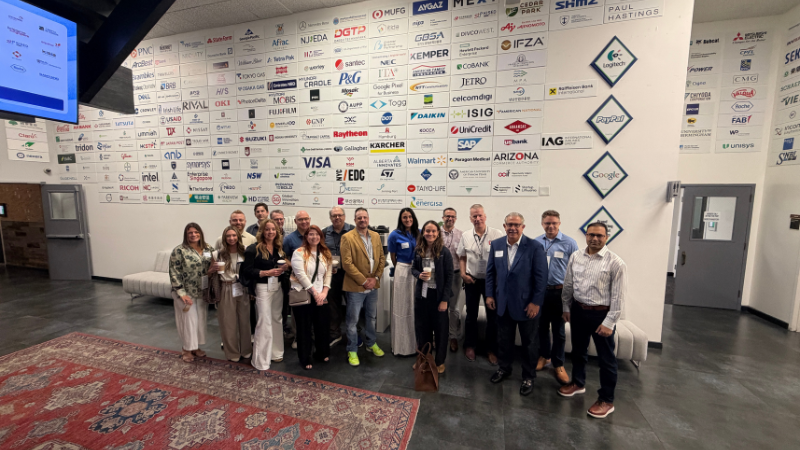
CHICAGO, August 18, 2026 — Plug and Play may not have the renown of a Google or an Amazon, but attendees of Go2MarketEdge quickly realized why the company was included in the conference’s tour of West Coast tech disruptors. All it took was one step into the firm’s headquarters.
Covering the walls are hundreds of signs and plaques, each bearing the name of a technology innovator that got its start with support from Plug and Play. Among the names: PayPal, Google, DropBox and SoundHound, to name a few. All told, Plug and Play has provided resources to more than 100,000 startups.
The company describes itself as a tech incubator and growth accelerator. Toward that end, the operation hears pitches from more than 100 startups per week at its 60-plus offices. Three or four startups will be chosen as potential partners.
Each of the selected ventures gets an investment of $50,00 to $350,000. Additional capital might come from one or several of the 300 venture capital firms that regularly work with Plug and Play. (In Silicon Valley, “startups aren’t competing for VCs,” said Plug and Play Investment Analyst Vasco de Castelbajac. “The VCs are competing for the startups.”)
The deal often includes a stipulation that Plug and Play can invest further in the startup later in its development. But Castelbajac noted that it doesn’t buy the concerns. Its role is to be an investor, not an owner.
The startups are also provided with office space if necessary, and the network of past and present beneficiaries can also be tapped for advice.
It’s a volume play; about 90% of the funded startups don’t generate the return expected by Plug and Play, or don’t do it within a timeframe preferred by the company, according to Castelbajac. About 50% go out of business, he added.
But the 10% that get traction more than compensate for the disappointments, he stressed. More than 35 of the ventures in Plug and Play’s portfolio are “unicorns,” or operations valued at more than $1 billion.
To provide a sense of the pitch process, Plug and Play brought in several of the ventures it backs to offer a mock pitch to G2ME attendees.
The company has another revenue stream in the form of what it calls “reverse pitches.” An outside concern comes to Plug and Play with a problem it’s hoping to resolve through technology. Plug and Play reviews the “ecosystem” of startups it has backed, selects ones that might have a solution, and invites them in to pitch the third party looking for tech help.
Although Plug and Play may not be a household name, it is well known in the tech community of Silicon Valley, in part because of its rags-to-riches origin.
Make that rugs to riches.
The company started as a Silicon Valley rug store that had more space than it could use, so it decided to take on a tenant. A tech startup in need of office space heard of the availability and signed on. Its name: PayPal.
The rug store was and still is owned by Saeed Amidi, an Iranian who’d moved to the United States after Muslim fundamentalists took control of the country in the 1970s.
The more Amidi learned about the tech world his tenant was hoping to upend, the more intrigued he became. PayPal ended up with an investment from its landlord as well as a lease.
Amidi has been investing in tech startups in the decades since.