CHICAGO, August 11, 2026 — If there was a common point to every presentation during Go2MarketEdge, it was the importance of underlaying any use of AI with ample, dependable data, be it generated in-house or supplemented with input from outside research providers.
Incorporating the outsourced content poses some challenges, since there are no standard ways of collecting, recording and parsing the data. A bridge usually had to be built for each pool of data the user wanted to tap.
But as conference attendees learned, that step is being eliminated through a new dynamic called Model Context Protocol, or MCP.
The technology essentially acts as a universal information retriever, able to pull input from a full array of data sources and seamlessly incorporate it into the user’s AI environment. And it can usually be done with the usual sort of AI prompts, written in plain language within the dialogue box.
“Your question gets asked and answered right inside the AI tool that your team already opens every single day,” said Adam Friedman, director of food & beverage solutions for the research company Datassential.
In layman’s terms, MCP uses AI to figure out how to talk to data caches, pull requested info back into the user’s platform, and put it into a form that the user’s system can digest. And it holds the promise of speaking with any data source, like a universal translation system.
“It’s like a universal USB-C port for AI,” said keynoter Tosh Rayadhurgam, who has built large-scale AI systems for such tech behemoths as Meta, Lyft and Amazon.
It’s also like a one-way valve. It can retrieve info from a permitted system but doesn’t let the source pull data back, noted Friedman.
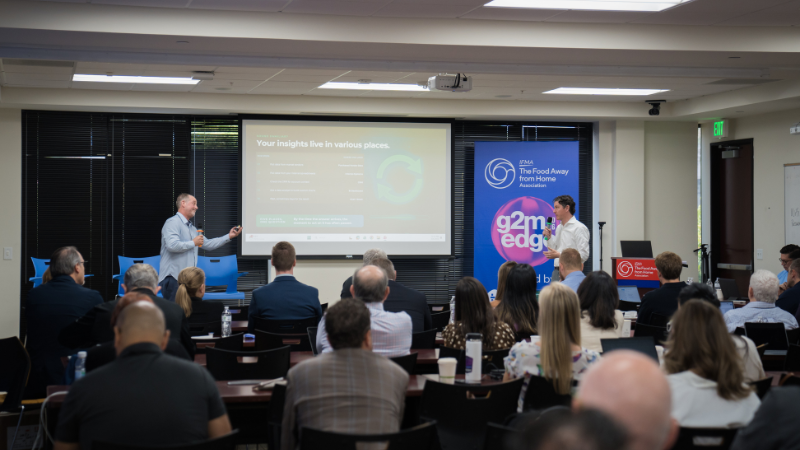
Attendees were given a firsthand demonstration by the Datassential executive and Jeff Wooledge, EVP of strategic insights for packaging supplier Dart Container Corp.
Suppose, Friedman said to Wooledge, "a customer comes to you and you get a request: Your team and you need a 30-minute presentation, you're meeting with one of your largest customers.”
Usually, said Wooledge, the prep would be a painstakingly slow process, in part because Dart’s salesforce includes a number of 30- and 40-year veterans who aren’t exactly familiar with the cutting edge of technology.
“They're used to sending an email to a team that would start to create a deck for them, and they would maybe start to reach out and collect some information,” he explained. “It can sometimes take weeks.
Dart has information about what it currently sells and what other items from its portfolio would work for their operation. But it might not have the industrywide trend indicators that would spotlight an opportunity the client isn’t yet exploiting. By using MCP, it could buy access to that deeper data from a researcher like Datassential, pull it into Dart’s system and generate a slide deck—all in a matter of minutes.
And because the request is posed in plain English, even the tech throwbacks would be able to pull the presentation together, said Wooledge.
G2ME was held in Silicon Valley by IFMA The Food Away from Home Association. Look here for more coverage from the 2.5-day immersion in AI.