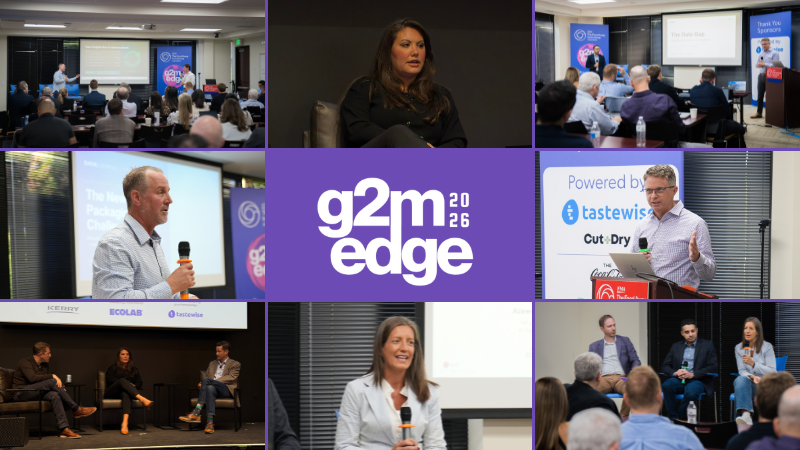
CHICAGO, August 11, 2026 — Shuttling from one AI giant to another in Silicon Valley, attendees of Go2MarketEdge were reminded of the technology’s revolutionary power.
“We want to cure all diseases,” Joana Carrasqueira, products & special products lead for Google DeepMind, told attendees in response to a question about the tech giant’s aims.
But the visiting food-away-from-home executives were repeatedly advised not to think any use they adopted has to be a gamechanger.
“Sometimes it’s putting really attainable small wins in front of a team,” said Bailey Gaul, senior brand manager for Kerry, the flavor and ingredients manufacturer. “Understanding those small examples, those small wins, those small practices, will pave the way” for bigger things.
As she noted, many individuals and organizations are fearful of falling behind the rest of the business world in wielding the power of AI. “There’s some fear about, ‘Am I behind? Is Kerry behind?,”’ she asked rhetorically.
“My advice: stop asking ‘What can AI do?’ and start asking, 'Where do we lose time or miss signals?’” said Ahmad Rushdi, director of Stanford University’s Human-Center Artificial Intelligence initiative. Reverse-engineer back from that point, he recommended.
“Spot those one or two questions that your team answers over and over,” advised Adam Friedman, director of food & beverage solutions for the researcher Datassential.
“I’d say go in and experiment,” said Azeem Kapadia, VP of enterprise AI transformation for Conagra Foodservice.
A common mistake among novice AI users is “analysis paralysis,” noted Kwesi Edwards, worldwide lead data migration and modernization specialist for Amazon AWS. So much data can be gathered and analyzed that full knowledge and certainty about the implications of an application is a moving target.
He recommended that adopters instead think in terms of setting up their programs as a “two-way door.” If the venture doesn’t unfold as expected, you can always retreat, review, regroup and try again.
“If you have 70% of the information that you wish you had, and it's a two-way door, you've already waited too long,” he advised. “Because that last 30% or 20% of information is going to take forever to get, and nine times out of 10, it's not going to help me make a better decision.”
Instead, Edwards advised, ask yourself, “Can we experiment in a low-cost way?”
He added that even the tech giants sometimes misfire. He recalled Amazon’s failed attempt to challenge the iPhone in 2014 with the Fire Phone. The mobile smartphone was a technological marvel, outperforming some of the established brands on the market, Edwards recounted. But the company neglected to foster the development of apps to expand the phone’s capabilities.
The product didn’t catch fire, but Amazon reaped considerable learnings, Edwards recounted. For instance, the microphone used for the phone became the one incorporated into Siri, Amazon’s AI virtual assistant. He asserted it’s best in kind.
Failure is part of the process, a number of speakers agreed. AI is often a process of re-iteration—trying something, learning from the experience, then employing those lessons in the next go-round.
“Failure isn’t an option, failure is required,” Conagra’s Kapadia said during a panel presentation on how food manufacturers are using AI. “The more you try, the more you fail.”
“There should be an acceptance of risk. You can always pull it back,” agreed his fellow panelist, Fleur Veldhoven, VP of marketing-culinary for Nestle Professional Solutions.
“There is a sense that this is hitting the proverbial easy button,” said Taylor Crown, global food-away-from-home lead for the consulting firm Accenture. “It’s not. It’s very hard.”
But being frightened into inaction is a bad choice, speakers agreed.
“There is a cost to maintaining the status quo,” Tony Neuman, senior director of foodservice marketing-institutional for Ecolab, said of doing nothing. “But that feels more comfortable.”